
From CDN observability to proactive investigation: what we’re testing with Hydrolix at IBC
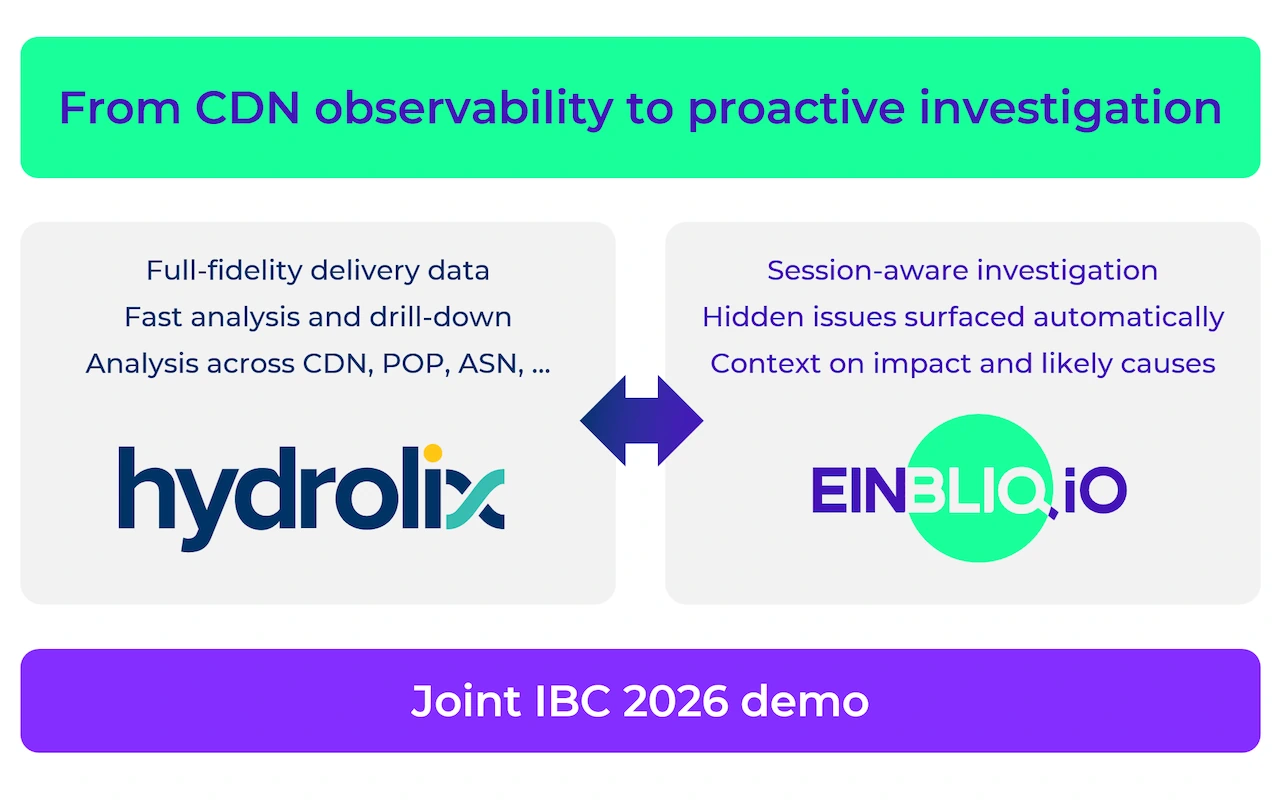
At IBC 2026, we’ll be showing a work-in-progress integration between Hydrolix and EINBLIQ.IO.
Hydrolix provides the data foundation: fast access to full-fidelity CDN telemetry across both real-time and long-term trends, with the ability to explore performance across dimensions and drill down into the underlying evidence.
EINBLIQ.IO adds proactive, session-aware investigation to that workflow.
Connecting delivery data with viewer impact
An HTTP error, an increase in segment delivery time or another CDN signal does not necessarily tell an operator how viewers were affected or whether the issue is actually significant. For example, a video player of a specific device type may request live segments before they are available, generating 404s without any meaningful viewer impact.
EINBLIQ.IO reconstructs playback sessions from CDN logs and derives session and QoE behavior such as ABR downshifts, playback-quality changes and unusual session patterns. Where CMCD is available, richer client-side signals such as buffer starvation can be added as well.
This lets us connect technical delivery evidence with what is happening at session level.
ML finds what deserves a closer look. Specialized agents investigate what changed, who is affected and why.
The architecture deliberately separates large-scale pattern detection from investigation.
ML continuously analyzes the session and delivery data to identify clusters worth investigating and determine what changed across relevant dimensions and signals.
Specialized agents then work through those selected cases and the supporting evidence to assess questions such as:
-
- Who and what is affected?
- Which signals changed together?
- Which dimensions distinguish the affected sessions?
- What are the likely contributing causes?
- Which underlying data should an operator investigate next?
This avoids asking agents to search enormous raw datasets themselves. Instead, they start with a focused evidence set and a clearly identified problem.
Bringing the investigation back into Hydrolix
The resulting context can be surfaced inside the Hydrolix workflow: affected time ranges and dimensions, viewer/session impact, likely causes and the evidence behind them.
Operators can then move directly from an identified issue into pre-filtered Hydrolix views and the underlying full-fidelity data.
This supports two common situations:
A visible issue: something already stands out in a dashboard, and the investigation context helps explain it faster.
A hidden issue: a smaller cohort, for example a CDN edge, ISP, CDN/ISP combination, specific media asset or device type, behaves differently even though the aggregate dashboard looks normal.
The objective is straightforward:
See visible issues faster. Surface hidden issues automatically. Narrow down likely causes.
The integration is still work in progress. We’re using IBC to demonstrate the approach, get feedback from streaming operations teams and understand where the combination creates the most value.
If you’re at IBC and would like to see what we’re testing, get in touch and book a meeting: